Made with all the love and care by Suhwoo © 2025
Other Projects
Optimizing logistics for faster ER patient transport
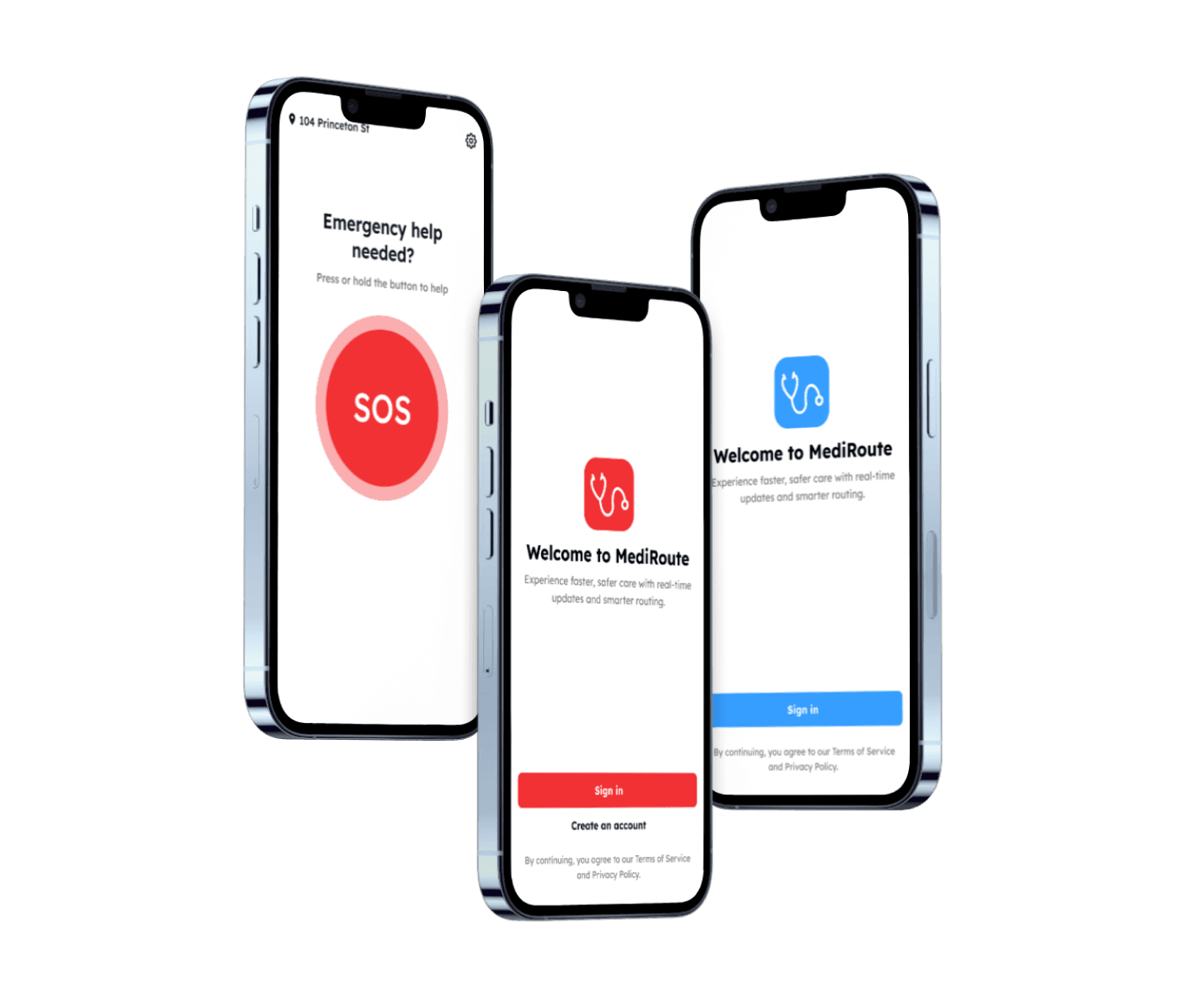
MediRoute eliminates "Ambulance Diversion" by integrating live hospital capacity into emergency navigation. Designed in a 24-hour sprint, this ecosystem ensures paramedics route patients to the right care immediately, not just the nearest building.
Context
Problem
Once the ambulance departs, communication goes dark. Drivers don't know if the destination ER has filled up until they physically arrive.
The Blind Spot

"Ambulance Diversion" occurs when full ERs turn patients away, forcing drivers to reroute in panic, wasting critical minutes.
The Bottleneck

Families call dispatchers repeatedly for updates because they have no visibility, clogging emergency lines needed for new 911 calls.
The Anxiety

Problem Statement - Static Data in a Dynamic Crisis
Current emergency routing relies entirely on distance, ignoring hospital saturation. This lack of real-time data forces ambulances to drive blindly into full ERs, resulting in Ambulance Diversion, a system failure where critical patients are turned away.
Goal - Zero Diversion Rate
To build a bi-directional ecosystem that routes ambulances based on availability rather than just proximity. We aim to close the communication gap so that paramedics can route patients to the right care immediately, ensuring no patient is ever turned away.
Pinpointing critical flaws in current dispatch systems
Emergency Department Crowding & Boarding
American College of Emergency Physicians

AI Applications in Emergency Medicine
Cornell University
Local woman raises concerns about overcrowding at Memorial
NBC Georgia
‘It was dystopian’: Family of patient describes overcrowded
NBC New York
Emergency Department Crowding: A National Data Report
National Library of Medicine
Ambulance diversion isn't just a logistical error; it's a recurring headline. We analyzed local news coverage to understand the human cost of delay, confirming that this is a systemic failure affecting major cities right now.
User Research
Mapping the journey from emergency call to arrival
Identifying gaps in existing navigation tools





Pros
Cons
Key
Takeaways
HIPAA-compliant
messaging with
hospital system
integration
Real-time data
feeds with CAD
and mapping tools
Accurate traffic and
route data with widely
familiar UI
Custom shift tools
with certification
tracking
Integrated transport +
care with mobile app
for ride assignment
Focuses more on
communication than
routing
Expensive for small
municipalities with
high learning curve
Not tailored to EMS
needs with no
hospital capacity
info
Not focused on
routing or hospital
data with legacy UI
Not available
nationwide and more
business-focused
than open platform
Communication is
critical, but routing
insights must be
layered on top
Strong technical
backbone, but user
experience for
paramedics may
be complex
MediRoute can
offer EMS-specific
routing logic beyond
public mapping tools.
Shows opportunity
to unify scheduling
and logistics with live
routing tools.
Business model can
be inspiration, but
MediRoute serves as
a universal tool.
Pulsara
RapidDeploy
Waze
EMS eSchedule
DocGo
Aspiration
Frustration
Interest
"Every second counts when transporting patients. I need real-time information about hospital capacity and the fastest routes to make the best decisions for my patients."
Arriving at overcrowded ERs
Not knowing patient info if unresponsive
Relying on outdated radio dispatch
Real-time traffic updates
AI-driven route optimization
Mike Rodriguez
EMT, Chicago

User Persona
Defining the frustrations of first responders
Hour

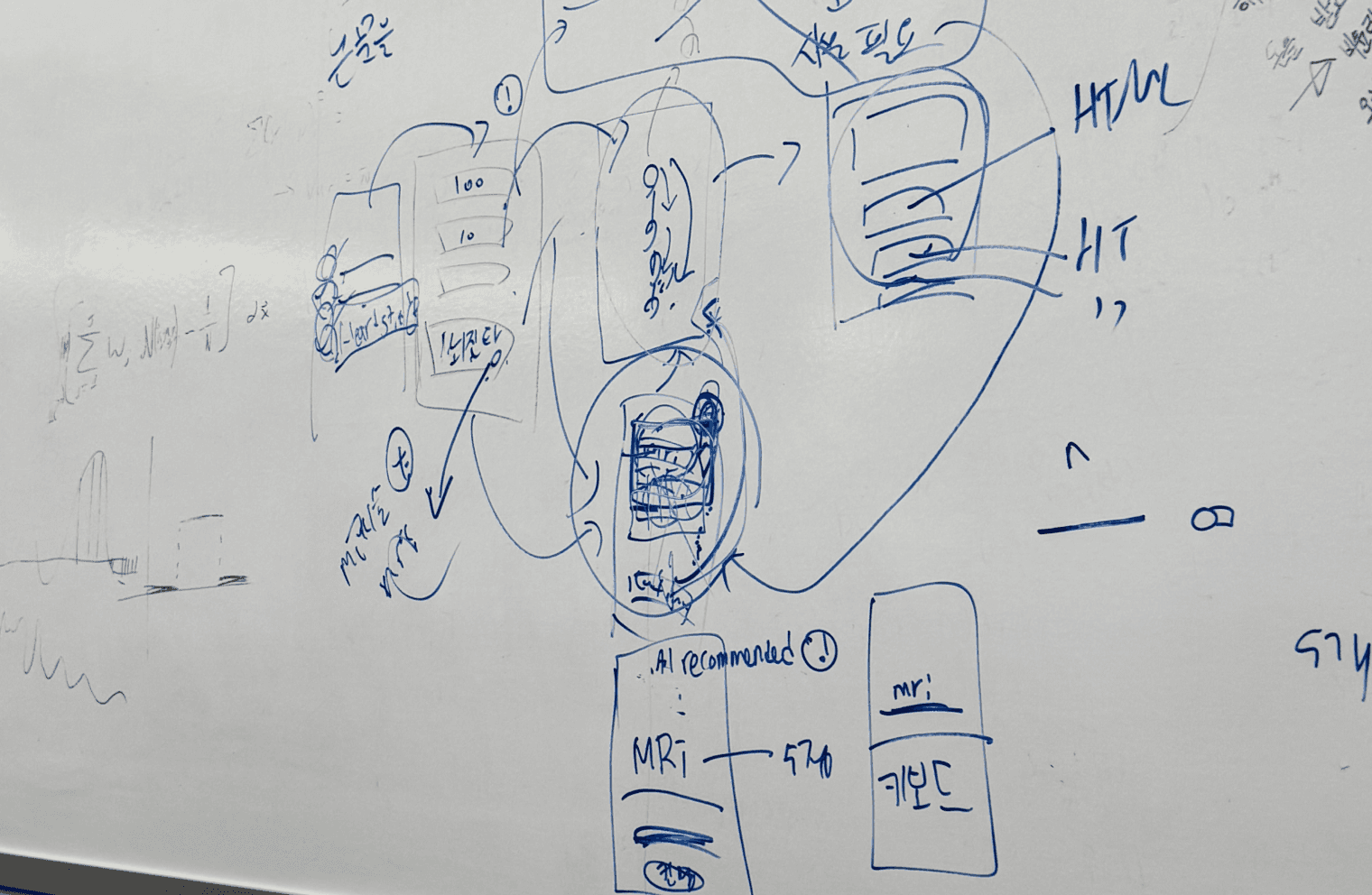

Action: We started by drawing the communication lines. We realized that while Dispatch talks to Ambulances, and Dispatch talks to Hospitals, Ambulances and Hospitals don't talk to each other.
Constraint: "We have 24 hours. We can't fix the whole 911 system. We have to fix the link."
Pivot: We shifted focus from a "Chat App" (too distracting) to a "Passive Navigation Layer" that pushes data automatically.
Ecosystem Mapping
Action: Paramedics rely on instinct. If an app tells them to take a longer route without a reason, they will ignore it. We engineered the routing logic to be Explainable.
Logic:
If Travel Time Difference < 5 mins
AND Destination Hospital Capacity > 95% (Code Black)
THEN Trigger Reroute + Show Notification: "Target Full."
Insight: "Transparency builds trust. The driver needs to know why the route changed."
The "Trust" Algorithm
Action: We skipped mid-fidelity and went straight to the final build. We enforced a strict design system based on physical constraints:
The 60px Rule: No touch target smaller than 60x60px to accommodate shaky hands in a moving vehicle.
Alert Red (#F23134): Reserved only for "Stop" or "Critical" actions to prevent desensitization.
Finish: "We stripped away 80% of standard map features (landmarks, POIs) to focus purely on the path."
The High-Fidelity Sprint
06-14
14-24
00-06
Process
Evolving concepts from rapid planning to wireframes
1
2
Clarity First
Information hierarchy is strict. Critical
data (Hospital Status) is immediately
accessible, while secondary info is
suppressed to prevent cognitive overload.
Speed & Accessibility
Minimized cognitive load for quick
decision-making. We utilized high
contrast and intuitive navigation to
ensure readability even when the user
is moving or distracted.
3
Trust & Reliability
A professional, medical-grade aesthetic
that instills confidence. The interface
avoids "gamification" elements to
maintain atone of serious operational
utility.
Typography:
Lexend
Lexend
Lexend
Lexend
Color Palette:
Primary Black (#141414)
Main Text & Headers
Primary Blue (#369EFF)
Usage: Primary Actions
& Branding.
Emergency Red (#FF412E)
Usage: Critical Alerts
White (#FFFFFF)
Usage: Backgrounds
& Secondary Elements.
Iconography & Elements:

Medical Icons
Status Indicators
Data Visualization
Standardized symbols
for universal recognition
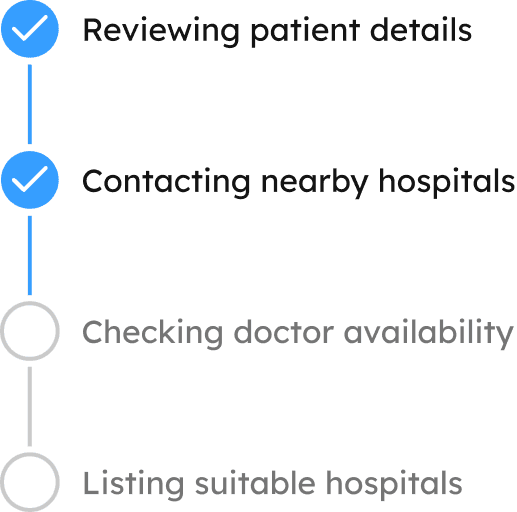
Clear visual cues
for hospital availability
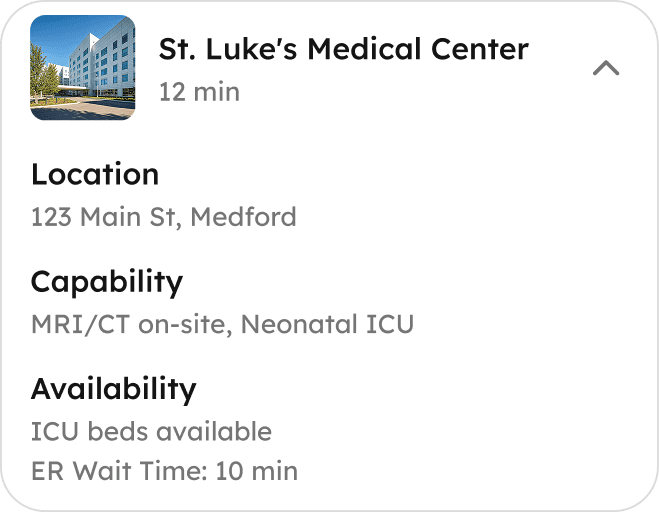
Simple charts
for capacity/wait times
Design System & Principles
Establishing a visual language of clarity and speed
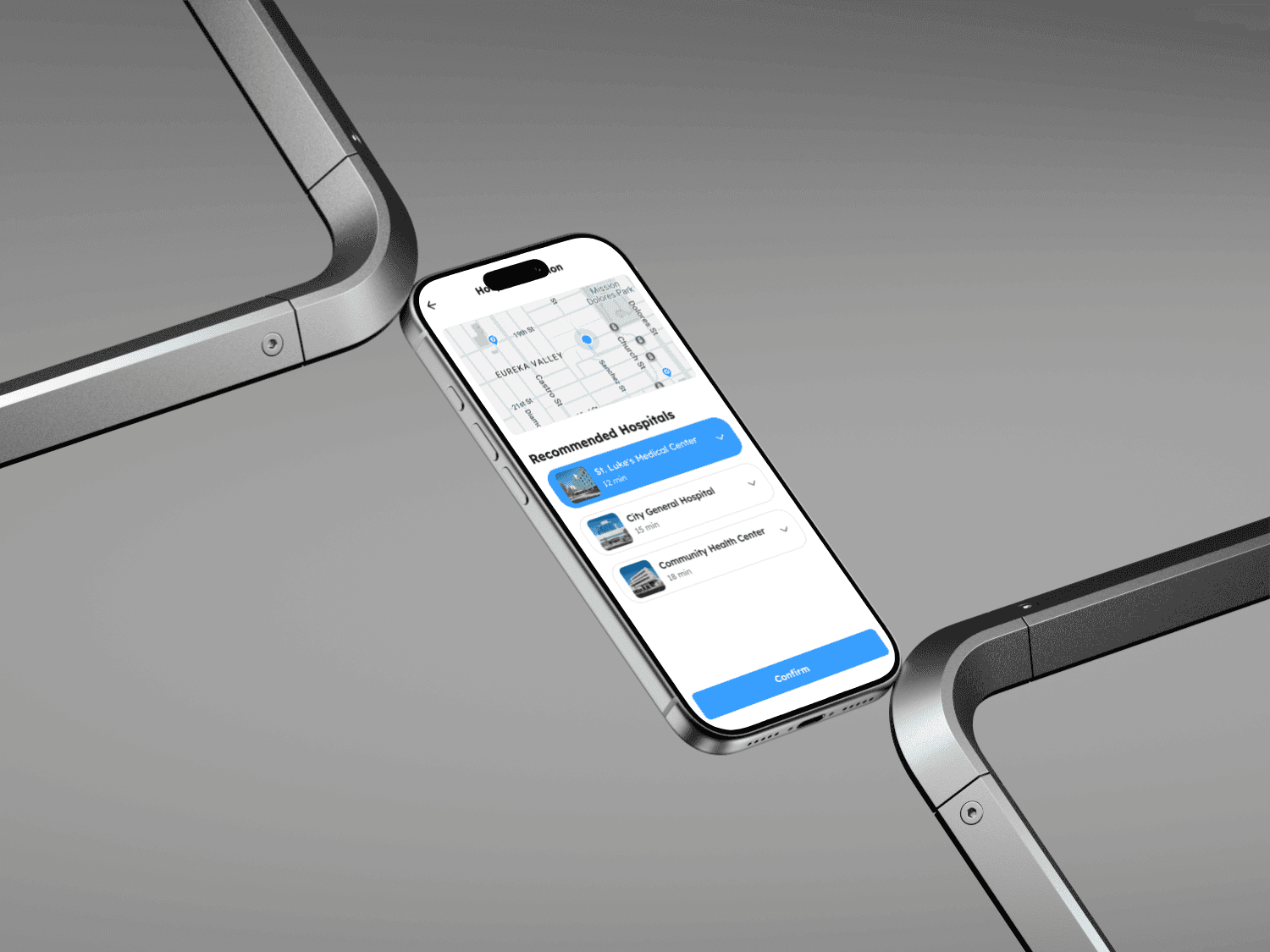
Intelligent routing system that analyzes
traffic conditions, hospital capacity,
and patient condition to determine the
optimal transport route and destination
hospital.
Emergency Call Routing
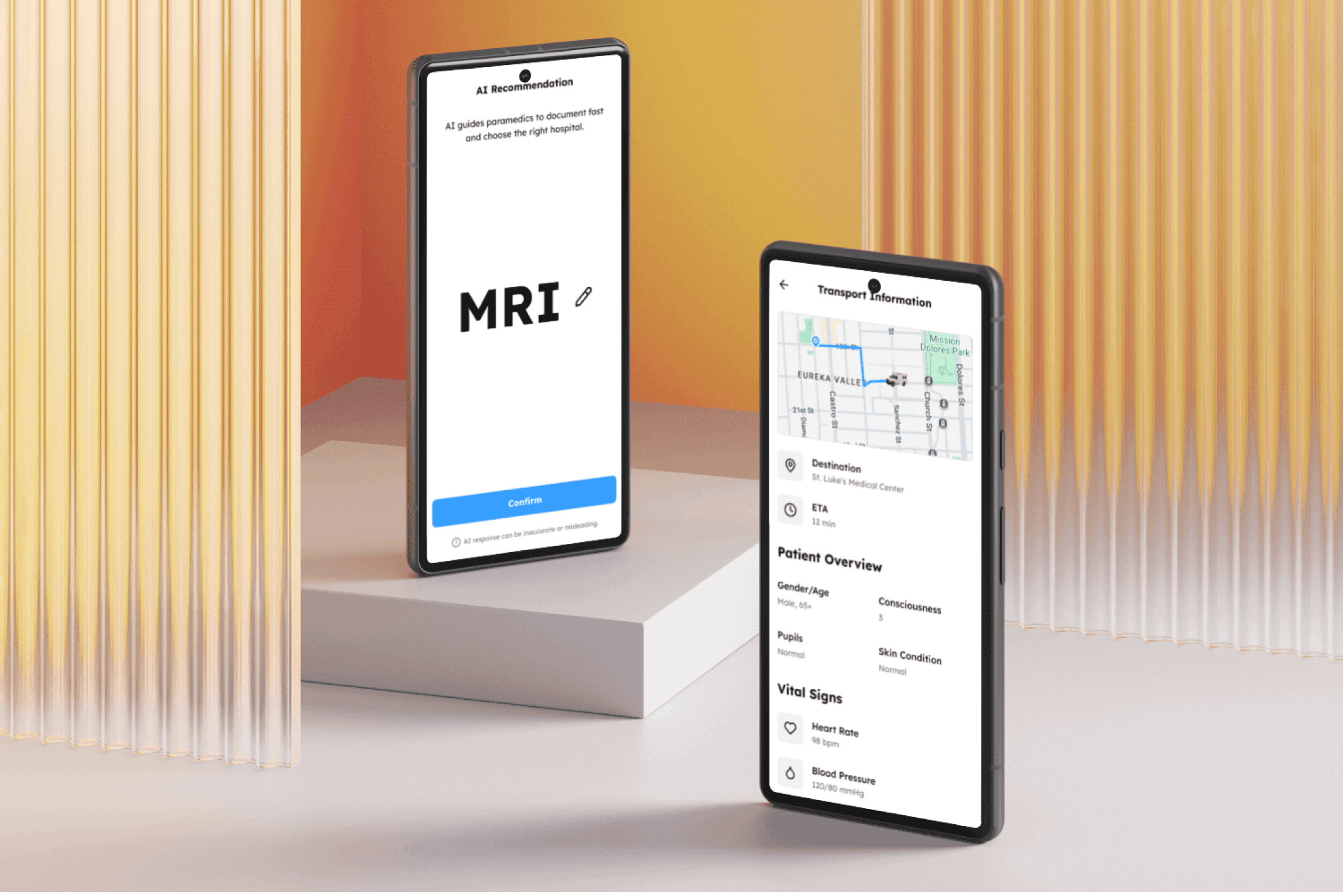
AI Recommendation
Synchronizing predictive clinical
intelligence with real-time capacity
data to eliminate the 'dystopian'
friction of emergency redirection.
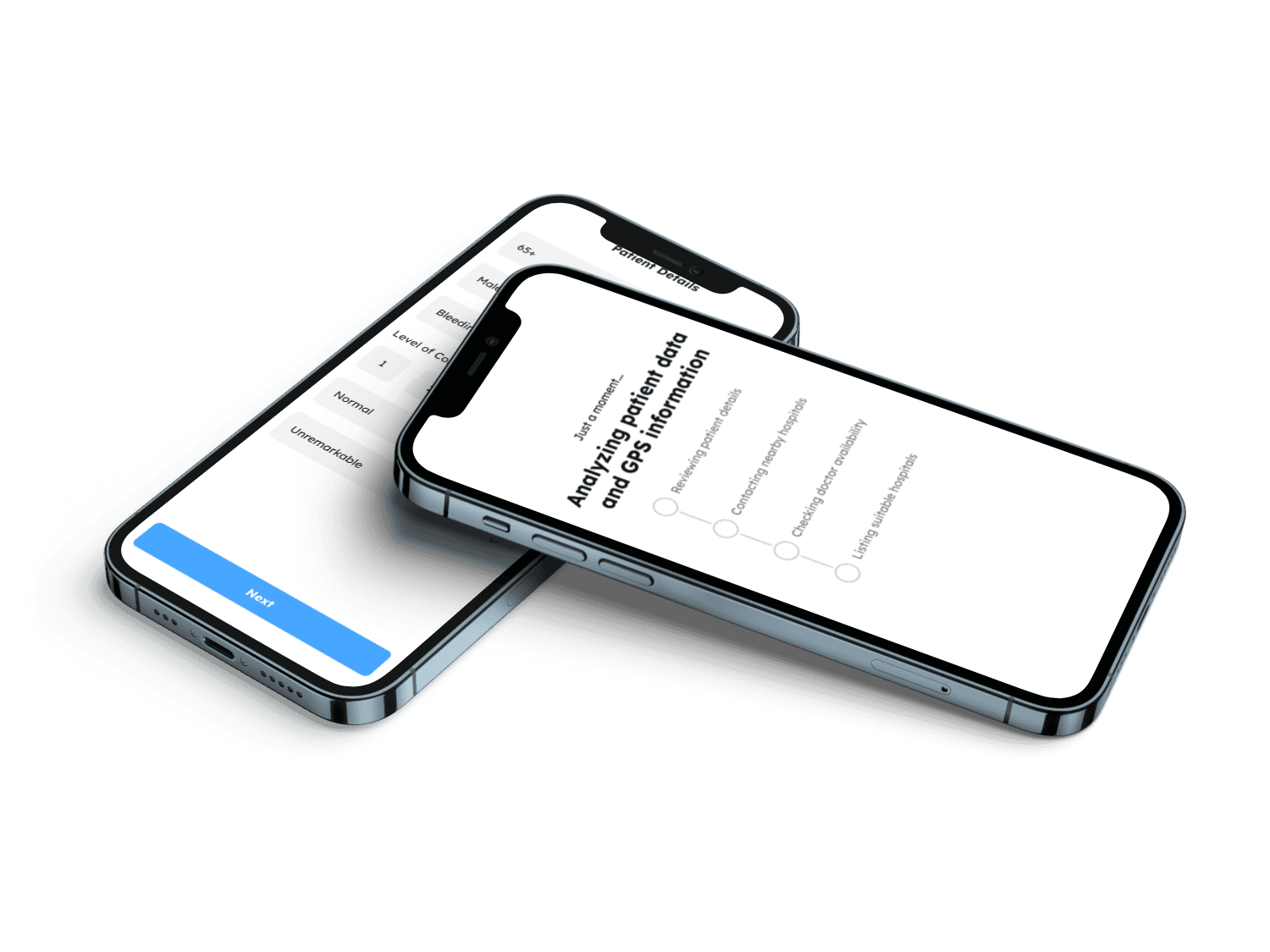
Symptom Assessment
Interactive symptom checker that
helps users identify potential
conditions and find appropriate
specialists based on their symptoms.
Key Features
Core tools for smart routing, tracking, and alerts
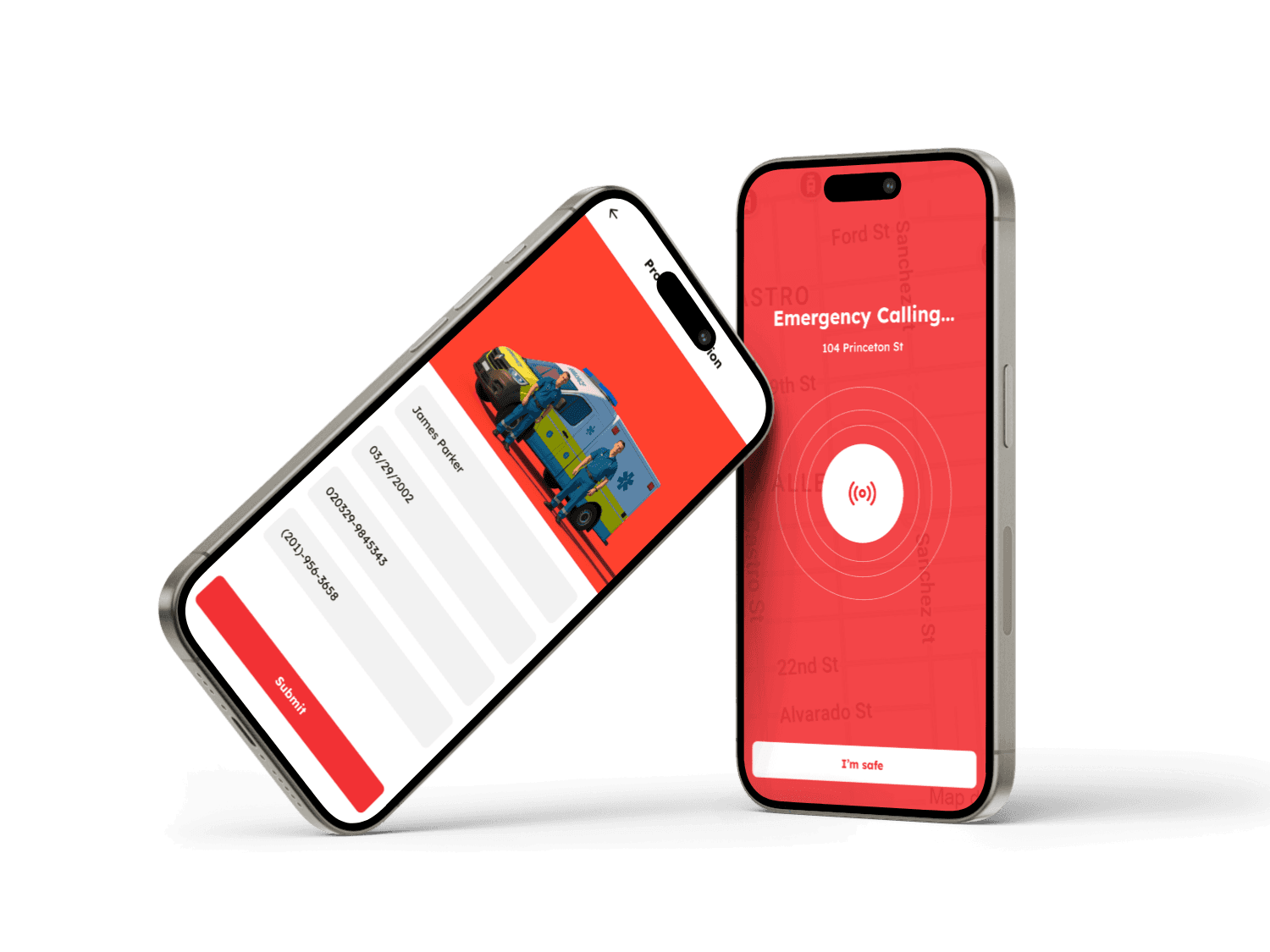
Visual Outcome
Polished interfaces designed for better decisions
The 24-hour limit was our best feature. It forced us to ignore 'nice-to-have' features and focus entirely on the 'must-haves' for survival.
We learned that in emergency UX, clarity is the only metric that matters. If a feature didn't shave seconds off the response time, we cut it. This project wasn't just about coding fast; it was about deciding what not to build.
🎙️
🏥
⌚
Voice Command Integration
Hands-free status updates so drivers can mark "Arrived" without lifting a finger off the wheel.
Future Iterations
Haptic Smartwatch Alerts
Wrist vibration patterns for left/right turns, allowing drivers to keep their eyes on the road 100% of the time.
Bi-Directional Triage
Allowing hospitals to view the patient's vitals during transit to prepare the exact equipment needed before the ambulance doors open.
Conclusion
Reflecting on the impact of streamlined emergency care




Role
UX
Designer
Team
2 UX
1 Frontend
1 Backend
1 PM
Timeline
1 Month
(Preparation)
24 Hours
(Hackathon)





MediRoute
Optimizing ambulance routing and hospital allocation to reduce critical delays in urban areas
Dream AI Hackathon
Destination
St. Luke's Medical Center
Estimated Time
12 min

